Frequently Asked Questions
The most-asked questions about legal systems & courts.
What exactly is a legal system and how does it function at a high level?
A legal system is the structured framework of rules, institutions, and procedures a society uses to resolve disputes, enforce rights, and maintain order. It typically involves legislatures creating rules, courts interpreting and applying them, and enforcement agencies ensuring compliance. Think of it as a layered machine where each branch checks and balances the others.
Who are the main 'characters' you'll encounter in a courtroom?
The core cast includes the judge (who oversees proceedings and interprets the law), the attorneys (who advocate for each side), the jury (who determine facts in many criminal and civil trials), and the clerk or bailiff (who handle logistics). Beyond the courtroom, prosecutors, public defenders, and appellate judges play critical supporting roles.
Where should a complete newcomer start to understand how courts work?
Begin by grasping the difference between criminal and civil cases, then learn the hierarchy of courts from trial level up through appellate and supreme courts. From there, trace the lifecycle of a single case—filing, discovery, trial, verdict, and any appeal—to see how each stage connects.
What's the fundamental difference between common law and civil law systems?
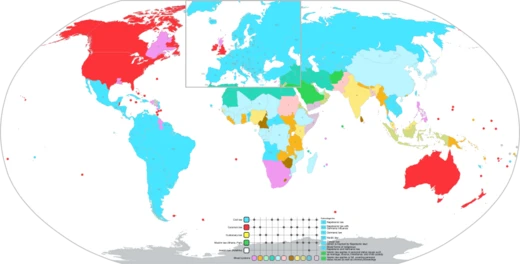
Common law systems (found in the US, UK, Australia, and others) lean heavily on judicial precedent, meaning past court decisions effectively become binding rules for future cases. Civil law systems (dominant across most of Europe, Latin America, and much of Asia) center on comprehensive written codes, with judges applying statutory text rather than creating law through their rulings.
What happens step by step when a case moves through a court?
A typical case progresses through filing a complaint, service of process, discovery (evidence exchange), pretrial motions, trial (opening statements, testimony, closing arguments), verdict, and then sentencing or a damages award. In criminal matters the prosecution must prove guilt beyond a reasonable doubt, while civil cases generally require only a preponderance of the evidence.
How do federal and state court systems divide their responsibilities in the US?
Federal courts handle constitutional questions, interstate disputes, federal crimes, and bankruptcy, while state courts adjudicate the overwhelming majority of criminal and civil matters like family law, contracts, and local criminal offenses. Each system runs its own parallel hierarchy from trial courts up to a supreme court at the top.
What are some landmark moments that fundamentally reshaped how courts operate?
Marbury v. Madison (1803) established judicial review, granting courts the authority to invalidate legislation that conflicts with the constitution. More recent shifts—such as the evolution of digital-evidence rules, the expansion of standing doctrines, and changing standards for adjudicating harassment claims—have all significantly altered day-to-day courtroom practice.
What concrete powers or tools can a court actually wield?
Courts can issue injunctions ordering someone to act or refrain from acting, award monetary damages, impose criminal sentences ranging from fines to incarceration, and in rare cases declare laws unconstitutional. They also control procedural levers like the scope of discovery, the admissibility of evidence, and the ability to dismiss or remand a case.
What's the most common misconception people have about how courts actually work?
Many picture dramatic TV-style confrontations, when in reality the vast majority of cases settle before trial and proceedings are heavily structured around written motions and procedural rules. Another frequent myth is that the judge 'decides everything' in a jury trial—actually, the jury determines the facts while the judge handles legal questions.
How does the appeals process work, and why is it important?
An appellate court reviews the lower court's legal reasoning and procedural conduct rather than re-weighing evidence, typically working from the written record and oral arguments. This second-look mechanism is essential for catching errors, ensuring consistency across jurisdictions, and developing coherent legal doctrine over time.