Administrative court
Specialized courts ensuring official acts comply with law.

Ahmed BEN YAGHLENE · CC BY-SA 3.0
An administrative court is a specialized court that handles disputes concerning administrative law, particularly those involving the exercise of public power. Its role is to ensure that official acts are consistent with the law, and it is usually considered separate from ordinary courts.
- jurisdiction
- Disputes over taxation, environmental licenses, immigration decisions, and other administrative acts
Lore & Background
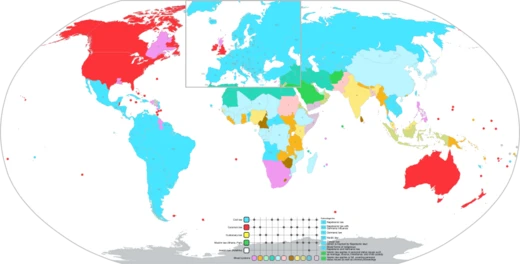
Administrative courts are recognized by their focus on acts that become binding without the consent of other parties. Contracts between authorities and private-law persons typically fall under general courts. Official decisions contested in these courts include taxation, monetary benefits, environmental licenses, building inspection, involuntary commitment, immigration decisions, and summary public payments. In several countries, a separate system of administrative courts exists alongside general courts, with no jurisdiction over each other. This parallel system appears in Austria, Egypt, Greece, Germany, France, Italy, some Nordic countries, Portugal, Taiwan, and others. The structure varies: France, Greece, Portugal, and Sweden have three levels (local, appeal, supreme); Finland, Italy, Poland, and Taiwan have two levels; Germany's system is more complicated and specialized. In Sweden and Finland, decisions of both state agencies and municipal authorities can be appealed to administrative courts. For municipalities, courts generally review formal legality, but in some cases they may also review the appropriateness or content of such decisions; for state agencies, they may rule on content. The United States does not have a separate system of administrative courts in the judicial branch. Instead, administrative law judges (ALJs) preside over tribunals within executive branch agencies, regarded as part of the executive branch due to separation of powers. Their decisions can be appealed to judicial courts. Some states, like Pennsylvania and Texas, have designated courts with exclusive appellate jurisdiction over administrative decisions.
Reader's Guide
Administrative courts matter because they provide a specialized mechanism for citizens and entities to challenge the legality of government actions. By separating administrative adjudication from general courts, many legal systems aim to ensure that disputes over public power are handled by judges with expertise in administrative law. The existence of parallel systems in numerous countries—from Austria to Taiwan—reflects a widespread recognition of the need for distinct oversight of executive actions. The variation in structure, from two-level to three-level systems, shows adaptation to different legal traditions. The United States' approach, using ALJs within executive agencies rather than separate courts, highlights an alternative model shaped by constitutional separation of powers. Overall, administrative courts serve as a check on executive power, ensuring that official acts conform to law, and their presence or absence significantly affects the balance between state authority and individual rights.
Did You Know?
- Administrative courts are usually considered separate from ordinary courts.
- In Sweden and Finland, administrative courts generally review the formal legality of municipal decisions, but in some cases they may also review their content or appropriateness.
- The United States does not have a separate system of administrative courts in the judicial branch; instead, administrative law judges preside within executive branch agencies.
The Core Mandate: Policing Public Power
Administrative courts exist to ensure that government actions remain tethered to the rule of law. Unlike ordinary courts, which typically resolve disputes between private parties, these specialized tribunals focus on a distinct question: whether an exercise of public authority complies with legal requirements. The defining characteristic of an administrative act is that it binds the parties involved without requiring their consent, setting it apart from private-law contracts between authorities and individuals, which remain within the general court system. The range of decisions that citizens can challenge before these courts is remarkably broad. Tax assessments, the granting or denial of monetary benefits, environmental permits, building inspections, child custody rulings, involuntary psychiatric commitments, immigration determinations, and summary public payments all fall within their purview. Notably, fines imposed by general courts are excluded from this jurisdiction. The courts do not simply rubber-stamp government action; their fundamental task is to verify that every official act, regardless of its subject matter, was carried out in accordance with the law.
A Patchwork of Parallel Systems
Across the world, countries that maintain a separate administrative court structure do so in varying degrees of complexity. In nations such as France, Greece, Portugal, and Sweden, the architecture mirrors the general judiciary with three tiers: a local court of first instance, an intermediate appeals court, and a Supreme Administrative Court standing apart from the ordinary Supreme Court. In Finland, Italy, Poland, and Taiwan, the structure is compressed into two levels, with the first-instance court operating at the regional level rather than the local one. Germany presents a notably more intricate arrangement, where the administrative judiciary is subdivided into multiple specialized tracks. Rather than a single unified hierarchy, German citizens may find themselves before the Federal Administrative Court, the Federal Social Court, or the Fiscal Court and Federal Fiscal Court, depending on the nature of their dispute. This specialization reflects the breadth of administrative law in a large federal state. The parallel system, where general and administrative courts hold no jurisdiction over one another, is also found in Austria, Egypt, and several other jurisdictions, creating a dual-track legal landscape that citizens must navigate.
The American Model: Executive-Branch Adjudication
The United States stands apart from the European and international tradition of maintaining a separate branch of administrative courts within the judiciary. Instead of dedicated courts, American administrative law is largely adjudicated by Administrative Law Judges who sit within executive branch agencies. This structural choice flows directly from the Constitution's strict separation of powers: because ALJs exercise quasi-judicial authority, they are constitutionally classified as part of the executive rather than the judicial branch. Citizens dissatisfied with an ALJ's ruling do not lack recourse; their decisions can be appealed to courts within the judicial branch. At the state level, some jurisdictions have carved out dedicated appellate pathways. Pennsylvania's Commonwealth Court and Texas's Fifteenth Court of Appeals, for instance, hold exclusive appellate jurisdiction over administrative decisions in their respective states. Beyond these, a vast ecosystem of Article I tribunals, state-level hearing offices, and local boards—ranging from California's Alcoholic Beverage Control Appeals Board to New York City's Tax Appeals Tribunal—collectively perform the review functions that a unified administrative court system would handle elsewhere.
Suppression, Revival, and Global Footprint
The history of administrative courts is not free from political interference. Today, the administrative court concept has a genuinely global footprint. In Africa, bodies such as the African Development Bank Administrative Tribunal and the Southern African Development Community Administrative Tribunal serve their regions. Asia hosts administrative courts or tribunals in Armenia, Azerbaijan, India, Mongolia, Sri Lanka, and Thailand. South America includes Colombia's Council of State. Europe offers the widest array, from Albania to the United Kingdom, where the Administrative Court operates as a specialist division within the King's Bench Division. Oceania is represented by Australia's federal and state tribunals and New Zealand's extensive network of specialized adjudicative bodies, from the Tenancy Tribunal to immigration-related authorities.
Gallery






Frequently Asked Questions
What is an Administrative court?
An administrative court is a dedicated tribunal whose sole purpose is to adjudicate disputes that arise from the exercise of governmental or public authority. Unlike general-purpose courts, it exists specifically to scrutinize whether official decisions and actions comply with the law.
What are Administrative court's powers and role?
Its core function is to review official acts—such as regulatory orders, licensing decisions, or enforcement actions—and determine whether they were carried out in accordance with statutory authority. If a public body overstepped or misapplied the law, the court can quash or annul that act.
What kinds of cases does Administrative court handle?
Jurisdiction typically covers disputes over taxation assessments, environmental permit and license decisions, immigration rulings, and a wide range of other administrative acts issued by government agencies. Essentially, any challenge to a public authority's exercise of delegated power falls within its purview.
How is Administrative court separate from ordinary courts?
It operates as a distinct branch of the judiciary, staffed by judges trained in public and administrative law rather than general civil or criminal matters. This separation allows for specialized procedures and expertise focused on the relationship between the state and the individual.
Why is Administrative court important to the legal system?
It serves as a critical check on executive and regulatory power, ensuring that governments cannot act arbitrarily or beyond the scope of their legal authority. Without this dedicated forum, citizens would lack a focused mechanism to challenge unlawful official decisions and hold public bodies accountable.
More in Legal Systems & Courts 1-24
Elsewhere in the Legal Systems & Courts universe
Spotted an error? Know more?
This is a living reference — every entry is fact-audited, and reader corrections feed straight into our audit queue. Suggest an edit · See this site's audit record