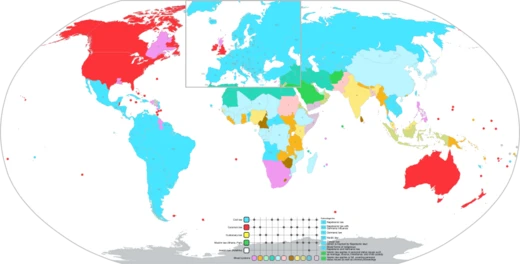
Administrative law
Branch of law governing executive branch agency activities.

Wikimedia Commons · Public domain
Administrative law is a division of law governing the activities of executive branch agencies of government. It includes executive branch rulemaking (regulations), adjudication, and the enforcement of laws, and is considered a branch of public law. Administrative law expanded greatly during the 20th century as legislative bodies worldwide created more government agencies to regulate social, economic, and political spheres.
- field
- Public law
- known_for
- Governing executive branch agencies, including rulemaking, adjudication, and enforcement
- scope
- International trade, manufacturing, environment, taxation, broadcasting, immigration, transport
Lore & Background
Administrative law deals with decision-making of administrative units of the executive branch. In civil law countries, specialized administrative courts often review these decisions. Over the last fifty years, administrative law in many civil law countries has opened itself to influence from supranational legal orders, leading to changes in traditional concepts such as public procurement and judicial control. However, contrary to some claims, the United Nations does not operate as a supranational administrative body directly administering policies like environment or education within member states; such supranational administrative structures are more characteristic of regional organizations like the European Union.
Reader's Guide
Administrative law is significant as it structures the relationship between government agencies and private persons, ensuring legality, fairness, and accountability in executive actions. In civil law jurisdictions, specialized courts apply distinct procedural rules, while common law jurisdictions often use general courts. The field has grown with the expansion of regulatory agencies in the 20th century, and more recently has been shaped by supranational legal orders, particularly in environmental and educational sectors. Its principles—such as legality, proportionality, and legal certainty—are central to modern governance, influencing areas from taxation to immigration. The development of administrative law in countries like China, France, Germany, Brazil, and Chile illustrates diverse approaches to controlling bureaucratic power and protecting individual rights.
Did You Know?
- Administrative law includes executive branch rulemaking, adjudication, and enforcement of laws.
- Civil law countries often have specialized administrative courts that review administrative decisions.
- In France, the Conseil d'État serves as the court of last resort for administrative cases.
Scope and Core Functions of Administrative Law
Administrative law sits within the broader family of public law, serving as the legal framework that governs how executive branch agencies operate. Its jurisdiction spans three primary functions: the creation of regulations (the executive branch's rulemaking), the adjudication of disputes, and the enforcement of existing statutes. The subject matter it touches is remarkably broad, reaching into international trade, manufacturing, environmental protection, taxation, broadcasting, immigration, and transportation. In essence, whenever a government agency makes a decision that affects citizens or businesses in these domains, administrative law provides the governing rules. Unlike private law, which typically mediates disputes between individuals or corporations, administrative law focuses on the relationship between the state's executive apparatus and the public it serves. This makes it a critical check on bureaucratic power, ensuring that agencies act within their legal authority while carrying out their regulatory mandates across the social, economic, and political spheres of daily life.
Twentieth-Century Expansion and Supranational Influence
The twentieth century witnessed a dramatic transformation in the landscape of administrative law. As legislative bodies around the world established an ever-growing number of government agencies to regulate the social, economic, and political dimensions of human interaction, the body of law governing those agencies swelled accordingly. What had once been a relatively narrow field expanded into a comprehensive discipline. More recently, over the past fifty years, countries rooted in the civil law tradition have seen their administrative frameworks open to the influence of supranational legal orders. In these systems, judicial principles carry significant weight, and their introduction has reshaped traditional concepts within the administrative law model. Changes have been particularly visible in areas such as public procurement and the judicial oversight of administrative activity. Beyond domestic reform, this supranational influence has helped build what can be described as an international public administration. Sectors like environmental protection and education have seen the United Nations system foster additional administrative structures designed to coordinate the activities of member states, creating a layered governance architecture that transcends national borders.
France's Administrative Courts and Continental Legacy
In civil law jurisdictions, administrative cases are typically channeled through specialized courts or dedicated sections, applying procedural rules distinct from those used in private law matters like contracts or torts. France stands as the most developed example of this approach. Its legal system operates on a dual jurisdictional model: the ordinary judiciary handles civil and criminal matters, while a separate administrative branch exercises authority whenever a government institution is a party. At the apex of this structure sits the Conseil d'État, serving as the final court of appeal for both ordinary administrative tribunals and intermediate appellate courts. Specialized bodies handle asylum, military, medical, and judicial disciplinary matters. Over time, French administrative courts crafted an extensive body of case law and legal doctrine—principes généraux du droit and principes fondamentaux reconnus par les lois de la République—often articulating rights such as fair trial, equal treatment in public services, freedom of association, and legal certainty before those concepts were formally codified in constitutional texts. This French tradition, known as droit administratif, has profoundly shaped administrative law in Belgium, Greece, Turkey, and Tunisia.
China's Administrative Law Revolution Since the 1980s
Before the economic reforms launched by Deng Xiaoping, modern administrative law in China was virtually nonexistent. Beginning in the 1980s, the country undertook a sweeping construction of a new legal framework designed to oversee its bureaucracy and establish disciplinary mechanisms within the Chinese Communist Party. That law was amended in 2014 to reduce the procedural burdens placed on those bringing such challenges. Several of these regulations were later elevated to full statutory laws.
Gallery



Frequently Asked Questions
What is Administrative law in simple terms?
Administrative law is a branch of public law that sets the rules for how executive branch agencies operate. It covers the full range of agency activity, from creating regulations to hearing disputes and enforcing statutes.
What are the three core functions Administrative law governs?
It oversees agency rulemaking (drafting and issuing regulations), adjudication (resolving disputes before the agency), and the day-to-day enforcement of laws. Together these three pillars define the legal boundaries within which an agency may act.
Why did Administrative law grow so much in the 20th century?
Legislatures around the world passed increasingly complex social, economic, and political regulations, which required the creation of numerous specialized government agencies. Administrative law expanded in parallel to provide the legal framework and oversight needed for those new agencies to function.
Which policy areas fall under Administrative law's scope?
Its reach spans a wide set of sectors, including international trade, manufacturing, environmental protection, taxation, broadcasting, immigration, and transportation. In each of these fields, administrative rules and agency decisions shape how the law is applied in practice.
Why do fans and legal students consider Administrative law important?
It is the primary legal mechanism that keeps executive branch agencies accountable, ensuring their regulatory and enforcement actions follow established procedures. Without it, the vast web of government regulation across trade, environment, immigration, and other sectors would lack a coherent legal structure.
More in Legal Systems & Courts 1-24
Elsewhere in the Legal Systems & Courts universe
Spotted an error? Know more?
This is a living reference — every entry is fact-audited, and reader corrections feed straight into our audit queue. Suggest an edit · See this site's audit record