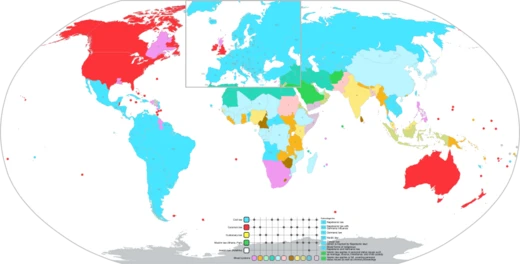
Judicial review
Courts review government actions for lawfulness and constitutionality.

Judicial review is a process under which a government's executive, legislative, or administrative actions are subject to review by the judiciary. In a judicial review, a court may invalidate laws, acts, or governmental actions that are incompatible with other laws. Judicial review is one of the checks and balances in the separation of powers—the power of the judiciary to supervise the legislative and executive branches when the latter exceed their authority.
- field
- Law and government
- known_for
- Power of courts to invalidate laws and executive actions incompatible with higher law
- key_concepts
- Separation of powers, checks and balances, ultra vires, legislative supremacy
- legal_systems
- Civil law and common law
- notable_example
- Marbury v. Madison in the United States
Lore & Background
Judicial review can be understood in the context of two distinct legal systems—civil law and common law—and two theories of democracy: legislative supremacy and separation of powers. Common-law judges are seen as sources of law, capable of creating new legal principles, while civil-law judges are seen as those who apply the law, with no power to create or destroy legal principles. The idea of separation of powers was first introduced by Montesquieu and later institutionalized in the United States by the Supreme Court's ruling in Marbury v. Madison, which established the court's power of judicial review to enforce the separation of powers stated in the US Constitution. The doctrine varies between jurisdictions. In the United States, judicial review is considered a key check on the powers of the other two branches of government by the judiciary. The judiciary in the United States has been described as having unusually strong powers of judicial review from a comparative perspective. Many countries whose legal systems are based on legislative supremacy have gradually adopted or expanded the scope of judicial review, including countries from both civil law and common law traditions. Some countries with common-law systems, such as the United Kingdom, do not have judicial review of primary legislation due to a strong attachment to legislative supremacy, though when the United Kingdom became a member of the European Union there was tension between its tendency toward legislative supremacy and the EU's legal system.
Reader's Guide
Judicial review serves as a fundamental mechanism for maintaining the rule of law and the separation of powers. By allowing courts to invalidate laws and executive actions that exceed legal authority or violate constitutional provisions, it provides a check on legislative and executive branches. The scope and procedure of judicial review differ between countries, reflecting underlying legal traditions and democratic theories. In common-law systems, judges may create or reject legal principles, while in civil-law systems judges apply existing law. The United States exemplifies strong judicial review, established through Marbury v. Madison, while the United Kingdom exemplifies legislative supremacy, where courts cannot strike down primary legislation. Judicial review of administrative actions is widespread, with some countries using specialized administrative courts and others using regular civil courts. The principle of ultra vires ensures public bodies do not exceed powers given by legislation. Judicial review remains a dynamic concept, with many countries expanding its scope over time.
Did You Know?
- Judicial review can invalidate executive decisions for being unlawful or statutes for violating a constitution.
- The United States judiciary has been described as having unusually strong powers of judicial review from a comparative perspective.
- In the United Kingdom, judges do not have the power to strike down primary legislation due to legislative supremacy.
- The idea of separation of powers was first introduced by Montesquieu and later institutionalized in the United States by Marbury v. Madison.
Frequently Asked Questions
What is judicial review in simple terms?
Judicial review is the process by which a court examines whether a government's legislative, executive, or administrative actions comply with a higher legal authority. If the court finds a conflict, it can strike down the offending law or action as invalid.
What powers does judicial review actually give to courts?
Through judicial review, a court can invalidate statutes, executive orders, or administrative decisions that clash with a constitution or a superior statute. This power serves as a check on the other branches whenever they exceed the authority granted to them.
What is the most famous case associated with judicial review?
Marbury v. Madison (1803) in the United States is the landmark precedent, in which the Supreme Court asserted its authority to declare an act of Congress unconstitutional. That ruling became the foundational basis for judicial review in American law.
How does judicial review fit into the separation of powers?
Judicial review operates as a core checks-and-balances mechanism within a separated-powers framework. It empowers the judiciary to supervise both the legislative and executive branches, preventing either from acting beyond its legally defined scope.
Does judicial review work the same way in civil law and common law systems?
Both civil law and common law traditions recognize some form of judicial review, but the scope and structure differ. Common law systems such as the U.S. allow broad court invalidation of legislation, while many civil law systems channel review through specialized constitutional courts or administrative tribunals.
More in Legal Systems & Courts 1-24
Elsewhere in the Legal Systems & Courts universe
Spotted an error? Know more?
This is a living reference — every entry is fact-audited, and reader corrections feed straight into our audit queue. Suggest an edit · See this site's audit record